What if the speed of light, gravity, and thermodynamic limits aren’t cold mechanical rules—but the biological homeostasis of a higher-dimensional being?
Imagine, for a moment, the life of a single white blood cell drifting through your bloodstream.
To that cell, “you” do not exist. It has no concept of your face, your memories, the code you write, or the room you are sitting in. Its entire universe is a warm, dark, rushing river of plasma bordered by rhythmic endothelial walls.
Yet that tiny cell lives under strict, unbreakable “laws of physics.” The temperature of its universe is locked at a rigid 37°C. The acidity of its environment is held between a pH of 7.35 and 7.45. Its ability to reproduce is capped by a hardcoded genetic counter (the Hayflick limit), and if it tries to multiply infinitely or drift into the wrong tissue, an invisible, unstoppable force triggers programmed cell death (apoptosis).
If that cell were philosophical, it might ask: Why is my universe governed by such arbitrary, restrictive laws? Why am I forbidden from growing forever?
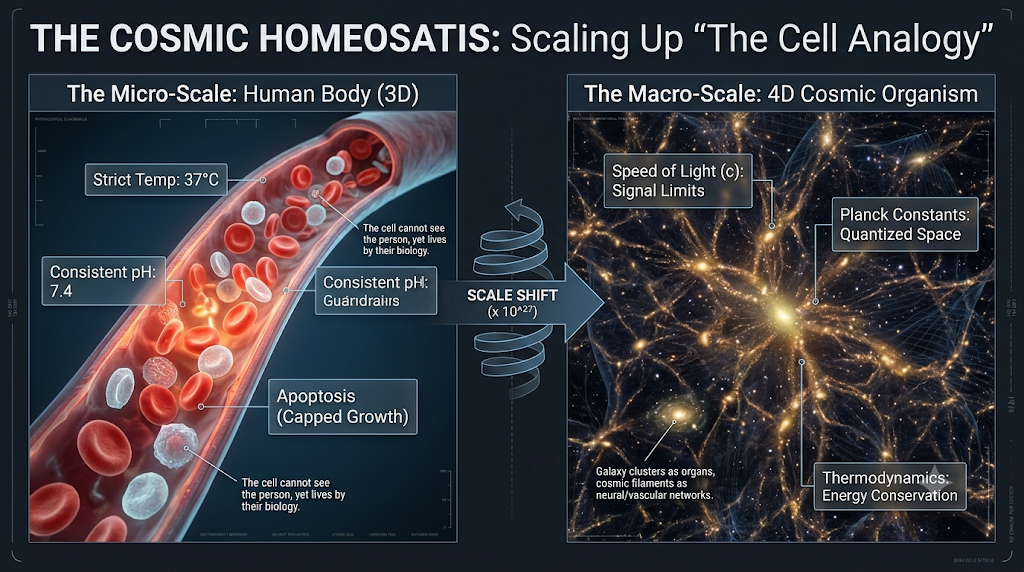
The answer is simple, though entirely invisible from the cell’s scale: those restrictions are not designed for the cell. They are the homeostatic guardrails keeping the macro-organism—you—alive.
Now, zoom out by twenty-seven orders of magnitude. Look at the laws of physics that govern our universe: the unbreakable speed limit of light (c), the bizarrely precise strength of gravity (G), the conservation of energy, and the relentless arrow of entropy.
What if our surroundings, our planet, and the cosmos itself are components of a living, higher-dimensional organism—and the laws of physics are simply its biology?
Stepping Up a Dimension: The Flatland Problem
The first objection to the idea of a “living universe” is usually visual: When we look through telescopes, we don’t see a giant creature; we see empty space scattered with isolated stars and galaxies.
But how would a higher-dimensional organism actually look to beings trapped in three dimensions?
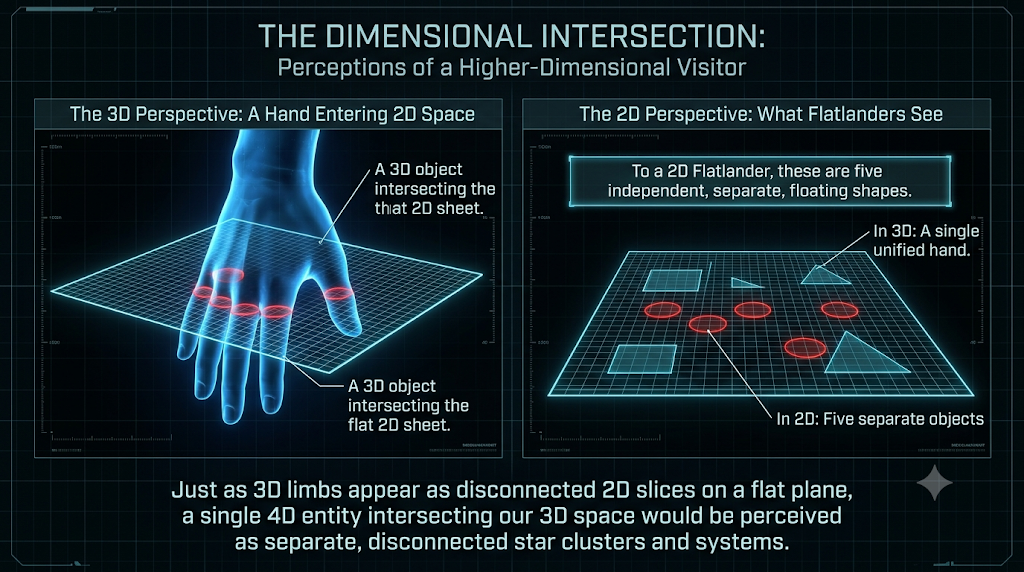
In 1884, mathematician Edwin A. Abbott published Flatland, a thought experiment about creatures living entirely on a two-dimensional tabletop. A “Flatlander” is a flat geometric shape, like a square, with width and length but zero height. It has no physical or mental concept of “up” or “down.”
If you—a three-dimensional human—decide to poke your hand down through the surface of Flatland, what does the Flatlander see?
They do not see a hand. Because they can only perceive the 2D cross-section where your flesh intersects their flat tabletop, they see five separate, disconnected circles (the slices of your five fingers) floating in empty space. To the Flatlander, those five circles look like independent islands separated by void. They have no way of knowing that just a few centimeters “up” in the third dimension, those five islands merge into a single palm, connected to an arm, driven by a single conscious brain.
Now scale that geometry up by one dimension:
- We are the Flatlanders, living inside a three-dimensional spatial slice.
- If a four-dimensional (or five-dimensional) entity intersects our 3D universe, we cannot see its unified body. We can only see its 3D cross-sections—isolated spheres of matter (stars, planets, black holes) and web-like filaments suspended in what looks like empty space.
- What appears fragmented and inanimate in 3D can be a single, continuous anatomical structure in 4D.
The Fine-Tuning Mystery as Biological Homeostasis
For the past half-century, cosmologists have wrestled with one of the deepest puzzles in science: the Fine-Tuning Problem.
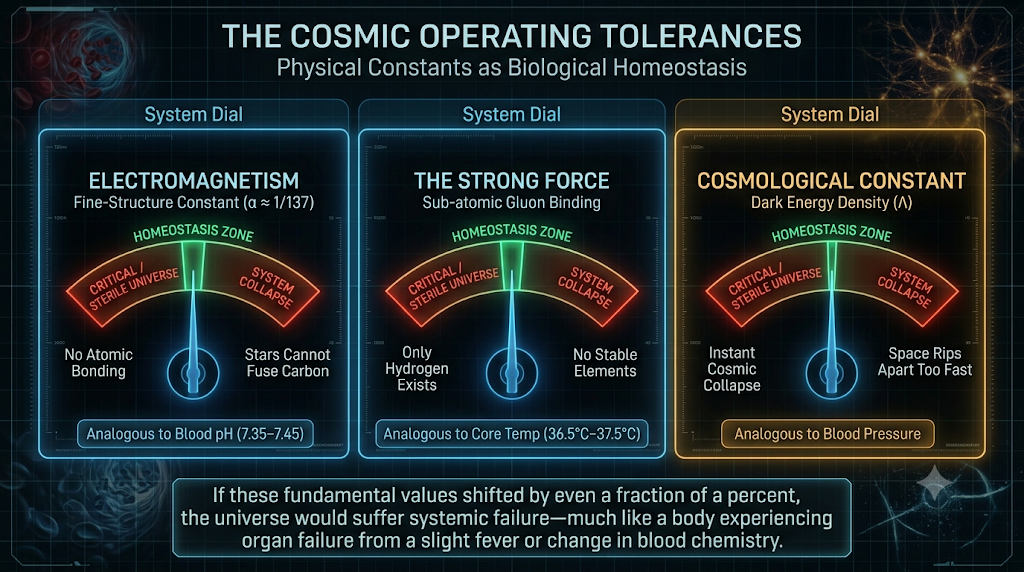
Our universe operates on roughly 26 fundamental dimensionless constants—numbers that cannot be derived from deeper equations and simply have to be measured. If you tweak almost any of these dials by a fraction of a percent, the universe becomes sterile and structurally dead:
- The Fine-Structure Constant (α ≈ 1/137): Controls the strength of electromagnetism. Shift it by just 4%, and stellar fusion can no longer produce carbon or oxygen.
- The Strong Nuclear Force: Increase it by 0.5%, and all hydrogen in the early universe fuses instantly into helium—leaving no water and no long-lived stars.
- The Cosmological Constant (Λ): Controls the expansion rate of space. It is fine-tuned to an astonishing 1 part in 10120. Any larger, and space rips itself apart before galaxies can condense; any smaller, and the universe collapses back into a gravitational crush.
In mainstream physics, there are generally two ways to explain this: either it is a lucky cosmic lottery ticket (the Multiverse hypothesis), or the universe was somehow “designed” for human life.
The Macro-Organism Hypothesis offers a third, far more grounded perspective. The universe isn’t fine-tuned for us, any more than your body’s 37°C core temperature is fine-tuned for the entertainment of a single gut bacterium.
Instead, look at how our fundamental physical laws map directly to physiological survival mechanisms:
- The Speed of Light (c ≈ 3 × 10⁸ m/s) as Nerve Conduction Velocity: Why does the universe have a strict cosmic speed limit? In any complex nervous system, signals cannot travel infinitely fast everywhere at once, or the system suffers catastrophic feedback loops (in the human brain, hypersynchronous runaway signaling is literally an epileptic seizure). By capping causal propagation in 3D space at c, local subsystems (galaxies and star systems) remain insulated from chaotic interference while developing complex internal structures.
- Thermodynamics as Metabolism: The First Law of Thermodynamics states that energy cannot be created or destroyed, only transformed—the exact definition of a closed metabolic system. Meanwhile, the Second Law (entropy) drives energy from concentrated hubs (stars) into dissipated work, powering the chemical complexity of planetary biospheres just like ATP hydrolysis powers cellular machinery.
- Gravity and Electromagnetism as Connective Tissue: On the macro-scale, gravity acts as the collagen and fascia holding galactic organs in place; on the micro-scale, electromagnetism acts as the lipid membrane keeping cellular atoms from passing through one another.
Where We Stand in the Anatomy
When we stop viewing the universe as a dead clockwork machine and start viewing it as a higher-dimensional physiological system, our entire relationship with nature shifts.
We stop asking why the universe refuses to let us build perpetual motion machines or travel faster than light through 3D space. A cell that breaks the metabolic rules of its host isn’t a hero conquering nature—it is a tumor threatening the very organism that keeps it alive.
But is this purely a philosophical metaphor, or does the physical structure of the universe actually match the anatomy of a living organism?
In Part 2, we will look at the hard mathematical data from a groundbreaking 2020 study by an astrophysicist and a neurosurgeon who ran the exact same structural algorithms on the human brain and the cosmic web of galaxies—and discovered that the two networks are nearly identical.

Amit Mittal is a seasoned tech entrepreneur and software developer specializing in SaaS, web hosting, and cloud solutions. As the founder of Bitss Techniques, he brings over 15 years of experience in delivering robust digital solutions, including CMS development, custom plugins, and enterprise-grade services for the education and e-commerce sectors.