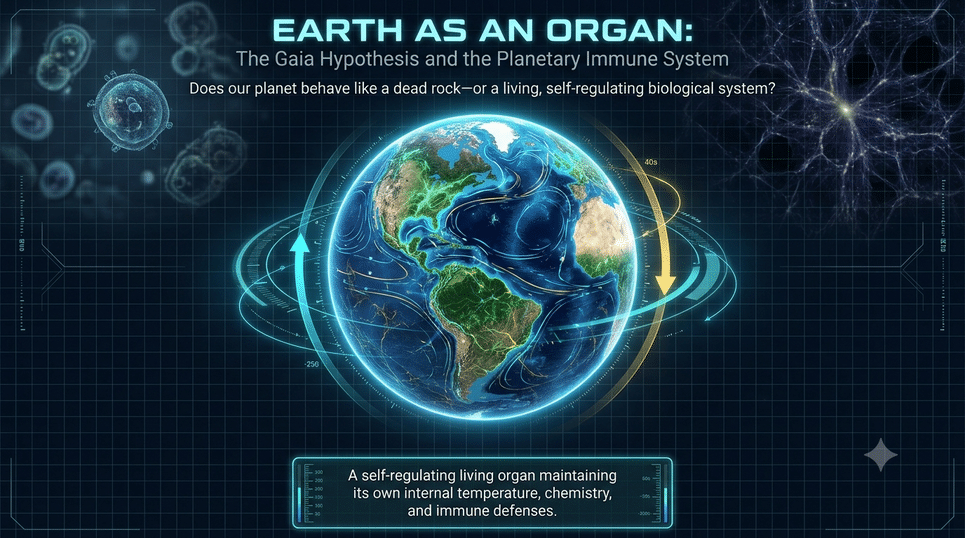
Why our planet doesn’t behave like a dead rock with life on top of it and why ecological crises look remarkably like a biological fever.
In Part 2, we uncovered a striking boundary in the 2020 Vazza and Feletti study: while the cosmic web of galaxies and the human brain share an almost identical network topology at massive scales, that mathematical overlap stops inside a single galaxy cluster.
That scale boundary tells us something profound about our address in the cosmos. Earth is not a neuron in the cosmic brain. Galaxy clusters are the neurons. Stars, solar systems, and living planets are the intracellular organelles and specialized organs—the mitochondria and metabolic engines operating inside a single galactic node.
If you accept that premise, an immediate engineering question follows: Does Earth actually behave like a living organ, or is it just an inert ball of silicate rock that happened to get lucky with some surface biology?
To answer that, we have to look at the planet’s telemetry over the last four billion years.
The NASA Problem That Sparked the Gaia Hypothesis
In the 1960s, NASA hired British atmospheric chemist James Lovelock to design instruments that could detect life on Mars. While his colleagues focused on building robotic scoops to dig for Martian microbes in the soil, Lovelock took a systems-level approach: Just look at the atmosphere.
Mars and Venus have atmospheres sitting in chemical equilibrium roughly 95% carbon dioxide, dead, stable, and unreactive, like the exhaust pipe of a car that ran out of gas billions of years ago.
Earth’s atmosphere, by contrast, is a screaming chemical anomaly. It is packed with reactive oxygen (21%) right alongside flammable gases like methane (CH4) and nitrous oxide, a mixture that should have reacted and burned itself out into a dead equilibrium millions of years ago. The only reason it hasn’t is that something is actively pumping energy into the system to hold it in dynamic disequilibrium.
Collaborating with evolutionary biologist Lynn Margulis in the 1970s, Lovelock formulated the Gaia Hypothesis (now formalized as Earth System Science): the biosphere, atmosphere, hydrosphere, and lithosphere do not operate independently. They are coupled together into a single, self-regulating physiological system that actively maintains the conditions required for its own survival.
Three Planetary Homeostatic Loops
Just as your body maintains a strict core temperature (37°C) and blood pH (7.35–7.45) through automated negative feedback loops, Earth runs its own suite of planetary-scale homeostatic controllers:
1. The Planetary Thermostat (The Faint Young Sun Paradox)
According to stellar astrophysics, our Sun is roughly 30% brighter today than it was 4.5 billion years ago when Earth formed. If Earth were a passive rock, it either should have been frozen solid for its first two billion years, or boiled into a runaway greenhouse like Venus as the Sun heated up.
Instead, Earth’s surface temperature has stayed remarkably locked inside the liquid-water window. How? Through the Carbonate-Silicate Weathering Cycle:
- When the planet warms (from solar brightening or volcanic CO2), ocean evaporation increases, driving heavier rainfall.
- Rain dissolves atmospheric CO2 into weak carbonic acid, which chemically weathers silicate rocks on land.
- Rivers wash those dissolved minerals into the ocean, where marine organisms lock the carbon into calcium carbonate shells, which sink to the seafloor and become limestone.
- Atmospheric CO2 drops, and the planet cools. If the planet gets too cold, rainfall slows, weathering halts, volcanic CO2 builds back up, and the planet warms.
It is a geological thermostat—functioning with the exact same negative-feedback logic as human sweat glands cooling a fever.
2. Atmospheric “Blood Chemistry” (The 21% Oxygen Cap)
Earth’s atmosphere has hovered around 21% oxygen for hundreds of millions of years—a razor-thin operating tolerance:
- Drop below 15%, and complex aerobic life suffocates; fire cannot even ignite.
- Rise above 25%, and even soaking-wet tropical rainforests would spontaneously combust from a single lightning strike, burning the biosphere to ash.
Photosynthetic forests, oceanic phytoplankton, and methane-producing microbes constantly titrate oxygen and carbon levels against each other, keeping the planetary “blood chemistry” inside that narrow green zone.
3. Oceanic Salinity Regulation (The 3.4% Lock)
Every year, rivers erode continents and dump roughly 4 billion tons of dissolved salts into the oceans. Over hundreds of millions of years, the seas should have turned into sterile, hyper-saline brines like the Dead Sea. Yet ocean salinity has remained stubbornly locked at ~3.4%—safely below the ~6% threshold where marine cell membranes rupture. Through evaporite salt flats, hydrothermal vent chemistry, and biological reef building, the planet continuously scrubs excess salt from its circulatory system.
Mapping the Anatomy of the Organ
When you view Earth through a systems-biology lens rather than a geology textbook, the planetary infrastructure maps cleanly onto familiar anatomical subsystems:
| Biological Subsystem | Planetary Equivalent | Core Physiological Function |
|---|---|---|
| Lungs (Alveoli) | Rainforests & Oceanic Phytoplankton | Continuous gas exchange, converting CO2 into O2 and regulating atmospheric chemistry. |
| Circulatory System | Thermohaline Ocean Currents & Jet Streams | Distributes thermal energy, dissolved nutrients, and moisture from equatorial hubs to polar extremities. |
| Peripheral Nervous System | Mycorrhizal Fungal Networks | Underground biochemical signaling webs linking root systems across entire forests to share nutrients and distress alerts. |
| Kidneys & Filtration | Wetlands, Estuaries & Silicate Weathering | Filters toxins, sequesters excess carbon, and balances mineral salinity. |
The Planetary Immune Response: Why Crisis Looks Like a Fever
This brings us to the most uncomfortable—and most illuminating—consequence of the Macro-Organism Hypothesis.
Inside a human body, every cell type has a defined role and a strict metabolic budget. When a single cell line overrides its local resource caps, multiplies exponentially, and floods the surrounding tissue with toxic metabolic waste, the host organism does not “hate” those cells. It doesn’t make a moral judgment.
It executes an automated immune response.
It spikes its core temperature—a fever—specifically to make the internal environment hostile to the runaway growth. It restricts nutrient supply lines. It triggers inflammatory cascades to flush the disruption out of the system so the organ can return to baseline homeostasis.
Now look at the Anthropocene through that exact lens.
Over the last two centuries, humanity has extracted hundreds of millions of years of sequestered carbon out of the geological crust and dumped it back into the atmospheric bloodstream in a geological eyeblink. We have cleared the planetary lungs (deforestation) and overloaded the filtration wetlands.
The resulting feedback loops—rising global temperatures, extreme thermal weather events, collapsing monocultures, and novel zoonotic pandemics—feel to us like cruel, arbitrary natural disasters.
To a self-regulating planetary organ, it is a fever. The biosphere isn’t “dying”; Earth has survived asteroid impacts, supervolcanoes, and Snowball Earth glaciations. The planet is simply executing a high-energy homeostatic correction to bring its thermal and chemical telemetry back inside its operating tolerances—whether the rogue cell line survives the fever or not.
Zooming Back Out: The Latency Problem
We now have a cohesive picture across three nested scales:
- The Laws of Physics (Part 1): The hardcoded homeostatic tolerances of a higher-dimensional host.
- The Cosmic Web (Part 2): A petabyte-scale, small-world neural architecture spanning 93 billion light-years.
- Earth (Part 3): A self-regulating living organ maintaining its own internal temperature, chemistry, and immune defenses.
Yet there is one glaring engineering flaw in this entire model—and every physicist or software architect reading this has probably already spotted it: Latency.
If galaxy clusters are the neurons of a cosmic brain, and the speed of light (c) is capped at 300,000 km/s, it takes tens of millions of years for a single signal to travel from one galactic node to its neighbor. How could a macro-organism ever maintain unified consciousness if its “thoughts” lag by millions of years?
In Part 4, we will tackle the ultimate cosmic engineering hack: how theoretical physics’ ER=EPR conjecture suggests the universe uses 4D quantum wormholes as zero-latency synapses to bypass 3D distance altogether.

Amit Mittal is a seasoned tech entrepreneur and software developer specializing in SaaS, web hosting, and cloud solutions. As the founder of Bitss Techniques, he brings over 15 years of experience in delivering robust digital solutions, including CMS development, custom plugins, and enterprise-grade services for the education and e-commerce sectors.