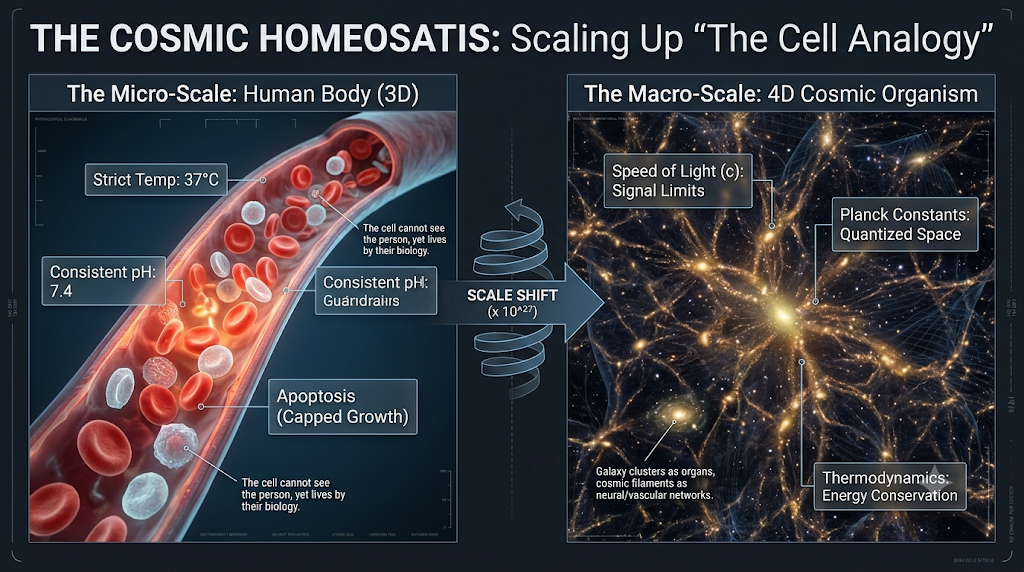
For decades, comparing the universe to a giant brain was dismissed as poetic pareidolia. Then an astrophysicist and a neurosurgeon ran the exact same code on both.
In Part 1, we explored a radical premise: what if our three-dimensional universe is the internal anatomy of a higher-dimensional organism, and the laws of physics are simply its homeostatic guardrails?
It is a compelling thought experiment. Yet any good systems architect or physicist will immediately ask for the telemetry: If the universe is a living organism, where is the tissue? Where is the nervous system?
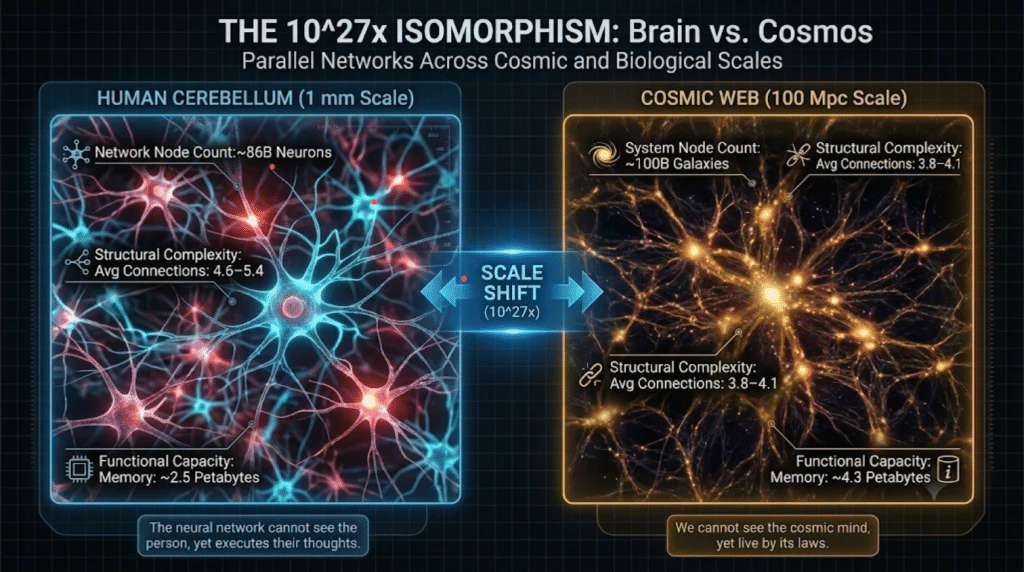
For years, anyone who placed a microscope image of human brain neurons next to a supercomputer simulation of the “cosmic web” of galaxies noticed an eerie visual similarity. Both look like tangled, luminous spiderwebs of glowing hubs linked by delicate filaments surrounding vast, dark voids.
Mainstream science largely shrugged this off as pareidolia—the human brain’s tendency to see familiar patterns in random noise, like spotting faces in clouds. After all, the human brain is governed by electromagnetism, biochemistry, and cellular genetics at the scale of micrometers (10-6 meters). The cosmic web is governed by general relativity, dark matter, and dark energy at the scale of megaparsecs (1022 meters).
Separated by 27 orders of magnitude, how could they possibly share anything more than a passing visual resemblance? In November 2020, two Italian researchers decided to stop guessing and actually run the math.
The Experiment: An Astrophysicist Walks into a Neurosurgery Lab
The collaboration brought together Franco Vazza, an astrophysicist at the University of Bologna, and Alberto Feletti, a neurosurgeon at the University of Verona. Their landmark paper, published in Frontiers in Physics, was titled simply: “The Quantitative Comparison Between the Neuronal Network and the Cosmic Web.”
To prevent visual bias, Vazza and Feletti stripped away the pretty colors and treated both systems as raw spatial datasets:
- The Brain Dataset: Feletti prepared ultra-thin histological slices (4 μm thick) of the human cerebral cortex and cerebellar cortex—representing ~86 billion neurons—and digitized the exact spatial distribution of neuronal cell bodies and axonal links.
- The Cosmic Dataset: Vazza generated a massive 400 Megaparsec cubic simulation of the universe (~1.3 billion light-years across) incorporating dark matter, glowing baryonic gas, and dark energy, slicing it into thin cross-sections that mirrored the microscope slides.
They then fed both datasets into the exact same suite of algorithms used in cosmology, graph theory, and information science. The results didn’t just show a casual resemblance—they revealed an uncanny structural isomorphism.
Finding 1: The “75% Passive Medium” Architecture
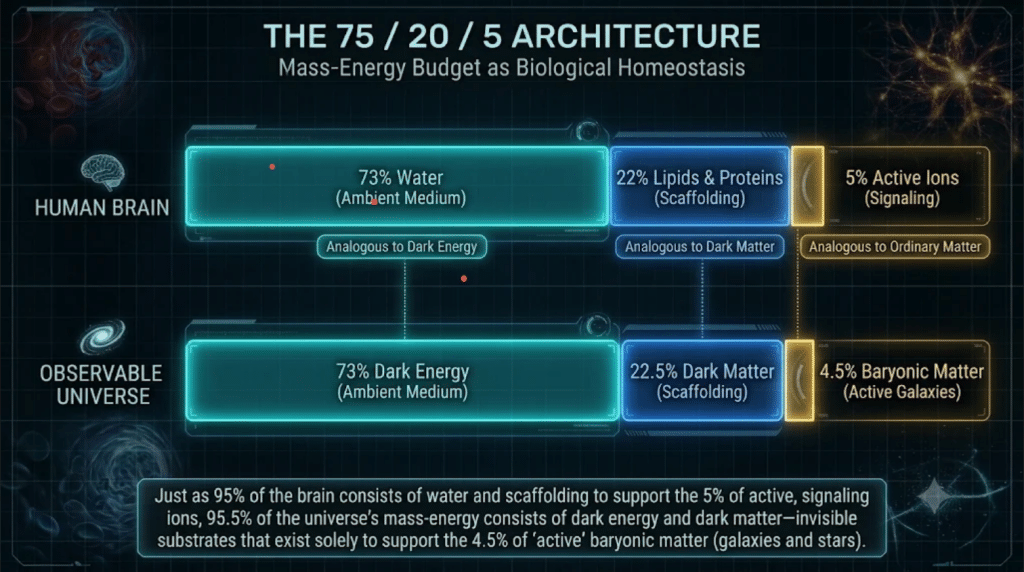
Before even looking at the wiring, Vazza and Feletti looked at the mass-energy budget of both systems. If you are building a complex signaling network, how much of your system is actual “wiring,” and how much is the ambient environment supporting it?
In both the brain and the universe, roughly three-quarters of the entire system consists of an invisible, passive medium (77% water in the brain vs. 73% dark energy in the cosmos), around a fifth acts as structural scaffolding (20% lipids/proteins vs. 22.5% dark matter), and less than 5% is the glowing, active matter we actually observe firing.
Finding 2: The Power Spectrum Overlap
To test whether the matter inside those two webs is distributed the same way, the duo used Fast Fourier Transforms (FFT) to calculate the spectral density (power spectrum) of both slices. When they scaled the metrics so that 1 micrometer in the brain mapped to roughly 0.06 to 0.1 Megaparsecs in space (a scaling ratio of 1.875 × 1027), the two curves locked onto each other.
Critics might ask: Doesn’t every natural fractal look like that on a log-log chart? Vazza and Feletti tested that exact objection by running the identical algorithm on sky clouds, tree branches, and water turbulence. None of them matched. The human brain’s power spectrum is mathematically closer to the cosmic web of galaxies than it is to a tree branch, a cloud, or even the interior of a single neuron.
Finding 3: Small-World Graph Topology & Memory Capacity
- Node Connectivity (Degree Centrality): A neuronal cluster in the human cerebral cortex averages 4.6 to 5.4 major connections. A galactic node in the cosmic web averages 3.8 to 4.1 filament connections.
- Clustering Coefficient (0.4 to 0.5): Neither system is a random mesh. Both organize into small-world networks—tight local clusters linked by long-range highway filaments, the exact architecture used in high-efficiency distributed computing to minimize routing hops across massive volumes.
- Total Memory Capacity: Using Shannon information theory, Vazza calculated that storing the entire structural configuration of the observable cosmic web requires roughly 4.3 Petabytes—compared to the ~2.5 Petabytes synaptic storage capacity of the human brain.
The Crucial Boundary: Where Do We Fit In?
There is one detail in Vazza and Feletti’s paper that makes the Macro-Organism Hypothesis click into sharp focus: the similarity stops below 1 Megaparsec (the scale of a single galaxy cluster) and below 10 micrometers (the scale of a single cell body).
That tells us that Earth and our solar system are not the neurons of the cosmic brain. The galaxy clusters are the neurons. Stars, planets, and biospheres like Earth are the intracellular organelles—the mitochondria and metabolic machinery operating inside a single galactic cell, generating the complex chemistry required to keep that node alive.
In Part 3, we will zoom in from the cosmic web to our own home planet—exploring Earth System Science and the Gaia Hypothesis, and why climate feedback loops and ecological boundaries look remarkably like a planetary immune response.

Amit Mittal is a seasoned tech entrepreneur and software developer specializing in SaaS, web hosting, and cloud solutions. As the founder of Bitss Techniques, he brings over 15 years of experience in delivering robust digital solutions, including CMS development, custom plugins, and enterprise-grade services for the education and e-commerce sectors.